
I believe there are similarities between what we expect from a job, and what we expect when we publish a book. According to a 2015 CNN Money poll, making money is down the list at #4. Here are the top 5:
- Respectful treatment in the workplace.
- Trust between management and employees.
- Benefits.
- Compensation/Pay.
- Job security.
It’s been this way for years and I doubt it will change. And in many of my initial conversations with authors, “making money” is not the first reason they give for writing a book.
The #1 goal is typically: I have something to share.
We have this fundamental urge to make a difference, to have our voice heard, to see if what we say helps or entertains other people.
So if income isn’t #1, and we want to reach as many people as possible, why do we put up walls around our books?
I think it’s because we are deathly afraid of being ripped off. I had an email this week along these lines.
A new author, with a niche topic book, wondered why his unreleased eBook was already available from another website, for free. (It wasn’t. These websites use newly released books to harvest emails from dishonest readers and nervous authors.)
I can empathize with the feeling that after all the work, and cash investment, some other person is going to get an undeserved benefit. But sometimes it can work in your favor.
The upside of piracy
DRM, or Digital Rights Management, is a setting you can choose when making your eBook available for online sale. Theoretically, when turned on, it protects your eBook from being shared, aka pirated. In the early days of the Kindle store (2008), major publishers insisted Amazon and other online eBook stores implement digital locks to prevent piracy.
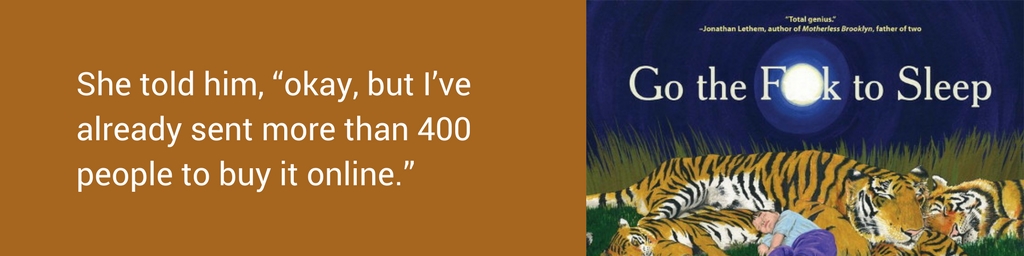
One of my favorite stories to illustrate the upside of piracy is the book Go the F**K to Sleep. The eBook copy in this situation was a PDF being sent to the printer, and it could not be protected with DRM. Finding it hilarious, one of the production staff shared it with a few friends, and from there it spread like wildfire.
I heard the story firsthand at the 2012 LA Times Festival of Books. Adam Mansbach, the author, told us of a call he made to a grandmother in Australia who had posted the entire book on her Facebook page. He offered to send her some autographed copies of the book if she took it down. She told him, “okay, but I’ve already sent more than 400 people to buy it online.” He said never mind, it was okay.
(Within a few months sales were on track for selling a million copies of book they thought might sell 10,000. It was also optioned for a movie.)
Encouraging piracy
There’s a story in The Perennial Seller, (reviewed here recently) about Paul Coelho pirating his own book by inserting the eBook into digital bundles (bit torrents) on sites in countries like Russia—without the permission or knowledge of his publisher.
He reportedly sold 10,000 copies in one year, but the next year he sold 100,000 copies. This is a popular author (165 million books sold) and he still found a way to expand his readership.
Who made it successful? The author, or the reader?
There are no winners if we write a book that no one reads. Assuming it was worth reading, we’ve deprived our potential audience of knowledge or enjoyment. We’ve not met our objective of making a difference, and perhaps acquiring some compensation for our efforts.
But let’s say that through some confluence of events and decisions, our book does make a difference. If it brings pleasure to many readers, and by doing so brings fame and fortune to us, who should benefit?
Victor Hugo was a staunch supporter of author’s rights. In fact, he was a founding member of a French organization which directly influenced the Bern Convention on copyright. Yet he is also quoted in his published archives as saying:
“any work of art has two authors: the people who confusingly feel something, a creator who translates these feelings, and the people again who consecrate his vision of that feeling. When one of the authors dies, the rights should totally be granted back to the other, the people.”
DRM, piracy and copyright in practical terms
The following are my personal opinions on these topics. They might need to be adapted for specific circumstances.
- Unknown authors. New authors should do all they can to introduce their writing to the public. I would not be concerned about piracy, or adding DRM to my book. I would price my book on the low side, especially the eBook, and look for opportunities to share as much as a third of the content (see below).
- Well-known individuals writing their first book. A traditional publisher is sure to open more doors, and put more marketing effort behind their celebrity author. But if I was self-publishing, I’d approach book marketing as an unknown author.
- Established authors. I would treat my first book like I was an unknown author, and use it as a calling card to introduce my other books. I’d be a bit more vigilant about piracy, but as Paul Coelho shows, it is possible to grow your readership through clever “marketing.”
- On DRM. I started out in favor of DRM, then changed to recommending selective use. Now I don’t see the point, and in fact I think it works against us.
- On sharing some or all of our books. I heard a well-known author say that we should give away as much as 40% of our books. He didn’t mean 40% in a single download. He suggested parts be shared in blog posts or guest articles, and different chapters as individual downloads for different markets. The probability that a single individual would accumulate all 40% is pretty slim, and assuming they do, they’re probably interested in the entire book at that point.
- Filing a formal copyright. You book is protected as soon as it is released in a fixed medium of expression. However, protection is easier if you file, and the effort and cost of filing is affordable. I can’t see a downside.
In fact, I’ll close by eating my own dog food. Click here to download the entire copyright chapter from my book, Register Your Book: The Essential Guide to ISBNs, Barcodes, Copyright, and LCCNs.